- With tighter monetary policy from the hawkish ECB, we expect economic activity to slowdown and enter into a recession in 2023
- Rate hikes from the ECB are unlikely to bring down inflation to ECB’s target level of 2%
- We expect loan loss provisions for EU banks to increase as asset quality weakens while growth in net interest margin to support earnings
- We see higher extension risks in CoCo bonds, thus we prefer AT1s with higher reset spreads due to mitigate extension risk
For the most part of 2022, Europe saw its economy hampered by persistently high inflation resulting from geopolitical tensions in Ukraine and supply chain disruptions. Inflation in the Euro-zone have reached decade high levels of 10%. Russia’s invasion into Ukraine have resulted in energy prices skyrocketing.
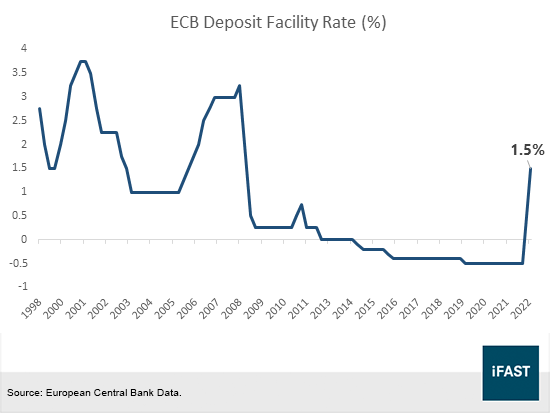
The once dovish European Central Bank (“ECB”) opted to raise its key interest rates in order to keep prices under control. Year-to-date, the ECB have raised its key interest rates 3 times, with its deposit facility rising from once negative rates of –0.50% to 1.50% (Chart 1).
Chart 1: Negative rates have since been raised by the ECB
With tighter monetary policy from the hawkish ECB, we expect economic activity to slowdown and enter into a recession in 2023. GDP in the Euro-zone is forecasted to be 0.3% in 2023 by the ECB, down from their July projections of 1.4%. Economic activity will be bogged down by higher consumer prices as inflation continues to stay “higher for longer”. Consumer prices will face headwinds resulting from the Russian-Ukraine conflict. Europe’s large dependency on Russian oil and gas is expected to put significant price pressures in the economy. Inflation have reached its highest levels not seen in years as rising energy prices sent prices soaring in 2022. In 2021, Europe accounted for nearly three quarters of natural gas exports from Russia with Germany being the most dependent - accounting for 19% of total gas exports from Russia. The switch away from reliance of Russian gas will difficult for Europe as the transition to liquefied natural gas (“LNG”) or any other forms of energy will not be a swift one.
Borrowing costs have also risen substantially from the increase in ECB’s key interest rates. This will also slow down further growth within corporates. The higher cost of borrowing will lead to higher interest expense and higher cost of refinancing for EU corporates.
Chart 2: Decade high inflation from rising energy prices in the Eurozone
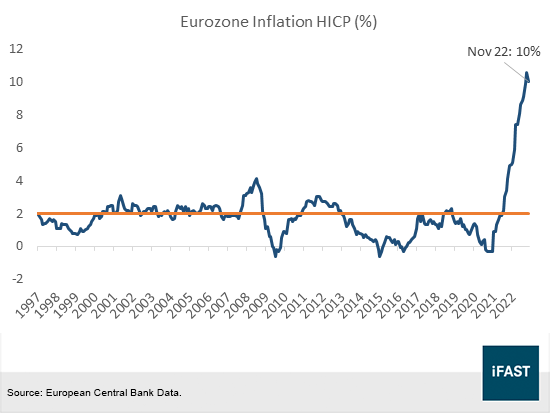
Rate hikes from the ECB are unlikely to bring down inflation to ECB’s target level of 2%. We believe inflation will likely stay elevated in the Eurozone as the conflict in Ukraine rages on, causing price pressures in energy prices, and dampening economic growth in the region. Inflation is likely to stay elevated as the Eurozone transitions into other forms of energy for their production needs. The transition will not be a swift one and prices will continue to be high as Europe thread through the energy crisis. Thus, with the weakening of economic activity in the Eurozone and tighter monetary policy, recession risk in the Eurozone have increased and we think the Eurozone is likely to enter into a recession in 2023.
The worst is yet to come for EU Banks
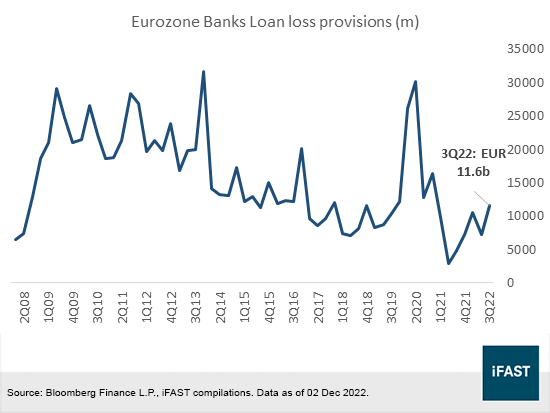
Weakening of the Eurozone economy: As Europe heads into a recession in 2023, lower economic activity and higher prices will hurt EU Bank’s asset quality. Non-performing loans (“NPL”) for EU banks have stayed fairly resilient and is on a downward trend since 2Q15 (Chart 3). Low interest rates and securitization of debt have brought about historically low levels of NPL. Banks have yet to fully provision against higher credit risk in its loans. In 3Q22, EU banks provided loan loss provisions of EUR 11,648.2m (Chart 4). The amount of provisions set aside for bad debts is significantly lower as compared to other recessions in 2008, 2012 and 2020. We expect default rates to rise in 2023 as the Eurozone suffers a contraction in economic activity. Asset quality is expected to fall as economic activity contracts and we believe banks have yet to fully account for the rise default rates in 2023. Looking ahead, we expect loan loss provisions for EU banks to increase as asset quality weakens due to the weakening of economic activity in Europe.
Chart 3: Non-performing loans saw a downward trend
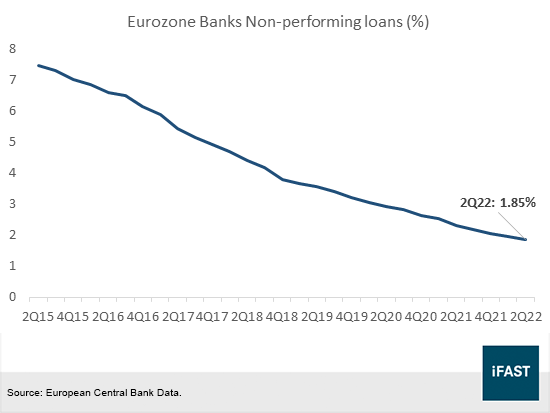
Chart 4: Loan loss provisions have yet to account for increased credit risk
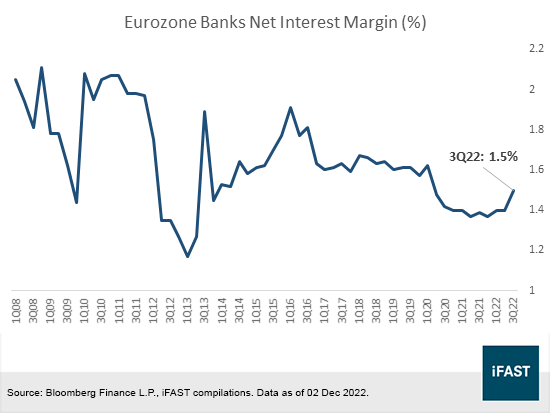
Net Interest Margins to buffer any slowdown in profits. We expect that higher global interest rates to support earnings due to the growth in net interest margin and net interest income. In 3Q22, net interest margin rose to 1.5% (Chart 5). Earnings will be supported by the rise in net interest income while we expect losses to come from Investment Banking and higher provisions for loan loss. Due to higher cost of funding and weaker equity markets, Investment Banking segments will see a continued slowdown in market activity.
Chart 5: Net interest margins to bolster bank earnings
EU Banks remain well-capitalised. In 1H22, the median Common Equity Tier 1 (“CET1”) ratio of Eurozone banks was 14.96% (Chart 6). CET1 ratio saw a decrease from 2021 due to higher risk-weighted assets (“RWA”) from the growth in credit risk RWAs. CET1 capital growth is limited due to higher share buybacks and increased dividend payouts. However, CET1 still saw an overall growth compared to previous years as banks continue to ensure they are well-capitalised after the global financial crisis in 2008. As of 3Q22, EU banks maintain a significant buffer over their regulatory CET1 requirements (Table 1).
All in all, we expect loan loss provisions for EU banks to increase as asset quality weakens due to the weakening of economic activity in Europe. However, we expect that higher global interest rates to support earnings due to the growth in net interest margin and net interest income. On their solvency, most banks have significant buffer over their regulatory CET1 ratio and should be resilient to thread through the period of slower economic growth.
Chart 6: CET1 ratio provide buffer over regulatory requirements
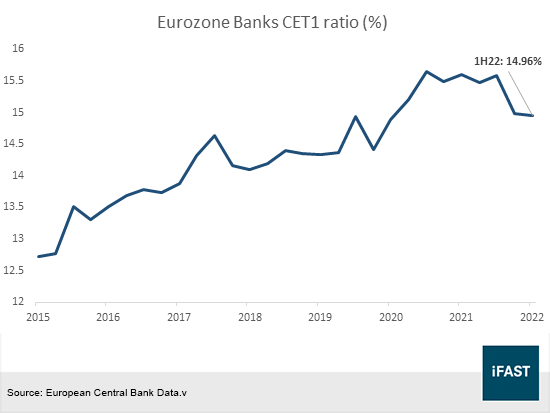
Table 1: CET 1 ratios of EU Banks
|
Bank |
CET1 ratio (as of 3Q22) |
CET 1 requirement |
CET1 buffer (bps) |
|
Barclays PLC |
13.8 |
10.9 |
290 |
|
BNP Paribas SA |
12.1 |
9.4 |
270 |
|
Commerzbank AG |
13.8 |
9.4 |
440 |
|
Credit Suisse Group AG |
12.6 |
10.2 |
240 |
|
Deutsche Bank AG |
13.3 |
10.4 |
290 |
|
HSBC Holdings PLC |
13.4 |
10 |
340 |
|
Lloyds Banking Group PLC |
15.0 |
10.2 |
480 |
|
Societe Generale SA |
13.1 |
9.27 |
383 |
|
Standard Chartered PLC |
13.7 |
10.2 |
350 |
|
UBS Group AG |
14.4 |
10.2 |
420 |
|
Source: Bloomberg Finance L.P., iFAST compilations. Data as of 15 Dec 2022. |
|||
Higher Non-Call Risk in CoCo bonds
We see higher extension risks in Banking Contingent Convertible (“CoCo”) bonds such as Additional Tier 1 (“AT1”) and Tier 2 (“T2”) bonds. In the past, banks would call back their CoCo bonds on their call date (usually 5 years from their issue date) and replace it with a similar AT1 or T2 instrument. This is because it was more economical for the banks to do so due to the low interest rate environment. Investors could take advantage of the higher coupons from these subordinated instruments while enjoying the “5 year” nature of the notes. However, with higher interest rates, the cost of refinancing CoCo bonds and replacing it with a similar new instrument have become less economical for the bank.
We have noted that the cost of issuing new NC5 AT1 bonds will be much higher than letting the notes reset. This would explain why we have seen some non-calls from issuers in 2022. Asian perpetual bonds took a hit after Korean life insurer, Heungkuk Life, reversed its decision to call its perpetual bonds on its call date on 9 Nov 2022. This may set a precedent for more non-calls from financial institutions to come, increasing extension risks in AT1s.
In the EU AT1 space, the European Central Bank have been flirting with the idea of limiting the possibility to call AT1 bonds if it is uneconomical for the bank. If implemented would mean that AT1 bonds can only be replaced with a cheaper AT1 instrument at a lower coupon rate. However, Credit Suisse’s redemption of its CS 7.125% Perpetual Corp (USD) in July was largely uneconomical as it replaced the 7.125% perps with the CS 9.750% Perpetual Corp (USD) when the 7.125% perps could have reset to a coupon of 8.2%. The implementation of this regulation would result in less calls for AT1s on their call date. However, we have seen largely the past year that most banks have gone ahead and called their AT1s even though it was uneconomic for them.
Our Coverage Universe
Our coverage on EU banks mainly focuses on SGD AT1 issuances. In the SGD AT1 space, 2 bonds had their call date in 2022 - HSBC 4.700% Perpetual Corp (SGD) and BAERVX 5.750% Perpetual Corp (SGD), both of which were redeemed on their call date.
Looking ahead, there are 7 AT1 bonds callable throughout 2023 and 2024. In Table 2, we estimated the cost of issuing a new AT1 bond, where we used the current I-spread + the indicative 5Y swap offer rate to estimate the coupon rate of issuing a new AT1 bond. We then compared the estimated cost of refinancing with a new AT1 bond with their respective indicative reset coupons.
Most SGD AT1s are still economical for the issuer to call. However, we believe spreads will still have room to widen as the fall in asset quality and profits from the economic contraction in Europe yet to be factored in. Thus, we prefer AT1s with higher reset spreads as it will lower extension risk as it will be more economical for the issuer to call back its AT1 bonds on its first call date.
We may consider a downgrade for the CS 5.625% Perpetual Corp (SGD) if client outflows continues to decrease in the next few quarters which would lead to the weakening of its Wealth Management, Asset Management and Swiss Bank divisions. Details on the transfer of Securitised Products Group and the spin-off of Credit Suisse First Boston have not yet been revealed by the bank. The failure to execute the exit of these assets may also lead us to reconsider the rating.
Table 2: SGD AT1s callable in 2023-2024
|
Bond |
First call date |
Current I-spread (bps) |
Reset rate |
Swap rate (%) |
Indicative Reset coupon (%) (a) |
Estimated cost of issuing new AT1 (%) (b) |
Estimated additional cost of issuing new AT1 (b-a) |
|
CS 5.625% Perpetual Corp (SGD) |
6 Jun 2024 |
634 |
5Y SOR+3.77 |
3.34 |
7.11 |
9.68 |
2.58 |
|
UBS 4.850% Perpetual Corp (SGD) |
4 Sep 2024 |
200 |
5Y SOR+3.37 |
3.34 |
6.71 |
5.34 |
-1.37 |
|
SOCGEN 6.125% Perpetual Corp (SGD) |
16 Apr 2024 |
462 |
5Y SOR+4.21 |
3.34 |
7.55 |
7.96 |
0.41 |
|
STANLN 5.375% Perpetual Corp (SGD) |
3 Oct 2024 |
183 |
5Y SOR+3.68 |
3.34 |
7.02 |
5.17 |
-1.86 |
|
UBS 5.875% Perpetual Corp (SGD) |
28 Nov 2023 |
89 |
5Y SOR+3.61 |
3.34 |
6.95 |
4.23 |
-2.71 |
|
HSBC 5.000% Perpetual Corp (SGD) |
24 Sep 2023 |
137 |
5Y SOR+2.67 |
3.34 |
6.01 |
4.71 |
-1.30 |
|
OCBCSP 4.000% Perpetual Corp (SGD) |
24 Aug 2023 |
218 |
5Y SOR+1.81 |
3.34 |
5.15 |
5.52 |
0.37 |
|
Source: Bloomberg Finance L.P., iFAST compilations. Data as of 12 Dec 2022. |
|||||||
Winter is coming for Europe
We expect Europe to head into a recession in 2023. With tighter monetary policy from the hawkish ECB, we expect economic activity to slowdown. Inflation is likely to stay elevated as the Eurozone transitions into other forms of energy for their production needs. The transition will not be a swift one and prices will continue to be high as Europe thread through the energy crisis. Banks have yet to fully provision against higher credit risk in its loans. Looking ahead, we expect loan loss provisions for EU banks to increase as asset quality weakens due to slower economic growth in Europe. However, we expect that higher global interest rates to support earnings due to the growth in net interest margin and net interest income. Among SGD CoCo bonds, most AT1s are still economical for the banks to replace with a similar new AT1 bond but we believe spreads still have room to widen and will cause refinancing to be more costly. Thus, we prefer AT1s with higher reset spreads due to mitigate extension risk in these bonds.
Declaration: For specific disclosure, at the time of publication of this report, IFPL (via its connected and associated entities) holds a position in CS 5.625% Perpetual Corp (SGD) and UBS 5.875% Perpetual Corp (SGD) and the analyst who produced this report holds a NIL position in the abovementioned securities.
Our podcast series, Yield Hunters, is available on Spotify, iTunes Podcasts and Google Podcasts. We share our thoughts on new bond issues and hold discussions on the fixed income space. Listen to our latest episode below and follow us!